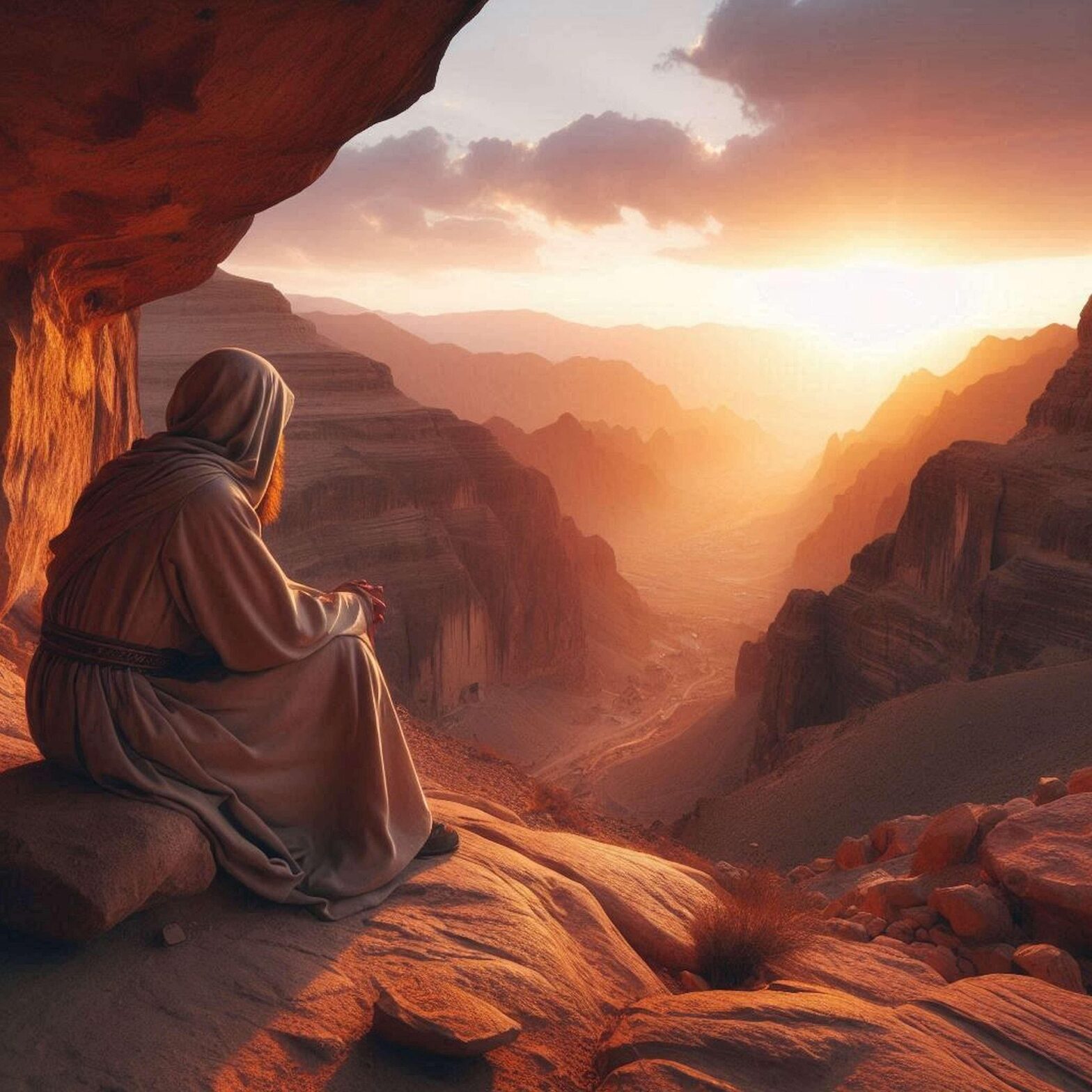
Have you ever had a topic placed forcefully upon your heart? A thought that starts as a tiny kernel, eventually blooming into a full discussion because everywhere you turn, you see the same message over and over again?
Such has been the case for me these last few weeks. In my morning devotionals, in social media, everywhere I have turned, I’ve seen the same story again and again… the bittersweet story of a slave named Hagar and her encounter with a sovereign God.
If you are unfamiliar with Hagar’s story, it unfolds in Genesis 16. Hagar was an Egyptian slave in the home of the Jewish patriarch, Abram, and his wife, Sarai. Interestingly, some scholars believe Hagar to be an Egyptian princess, given by her father, Pharoah, to be a handmaiden to Sarai. Either way, Hagar is far from home, living a lifestyle to which she’s likely unaccustomed.
Our story picks up a few years after God had promised Abram that He would make him the father of many nations. The text tells us, however, that Sarai remained childless until she was “advanced in years.”
Sidenote: I love this phrasing, so much. I will be writing “advanced in years” when filling out demographic forms from here on out.
After years of infertility, Sarai became desperate for a child, and that desperation led to the birth of Ishmael, a child born via surrogacy via her servant, Hagar, and her husband, Abraham.
This is where the story got messy, as one would expect, and their “situationship” gave birth to more drama than Sarai and Abraham bargained for. It went a little something like this:
- Hagar threw some shade against Sarai for being infertile once Ishmael was conceived;
- Sarai volleyed back and blamed her husband;
- Abraham chose the cowardly route and gave Sarai free reign to make Hagar’s life miserable;
- Sarai indeed made Hagar’s life miserable;
- Pregnant Hagar decided to run away.
I’m a sucker for drama, and this story has almost as much drama as a reality show on Hulu.
Can you picture it, though? Can you feel Hagar’s fear and hopelessness? While no one knows her age with certainty, we know Hagar was young when she was exploited by Sarai and became pregnant by Abram. The mistreatment she experienced was apparently so harsh that it drove her to run away, back to her Egyptian homeland, knowing that she would likely not survive the journey. She was a foreigner and a fugitive, traveling alone through the rough wilderness. More than that, she was a young, pregnant, unmarried woman in a country that deals quite harshly with young, pregnant, unmarried women.
It is safe to assume that Hagar was in a bad place – geographically, physically, and emotionally.
Almost There
Genesis 16:7 tells us that, “The Angel of the Lord found her by a spring of water in the wilderness, on the road to [Egypt by way of] Shur.”
Geography was never my strongest subject, so I had to look this one up. The well of water on the road to Shur is essentially at the southern border of the Israeli wilderness, near the northern edge of Egyptian territory. When the Angel of the Lord found her, this Egyptian slave woman was possibly less than a day’s journey from her homeland. She was almost there.
And it’s in this place of “almost there” that Hagar first encounters God and His sovereignty.
The Bible tells us that the Angel of the Lord listened to her story and then gave her a shocking command that he backed with an extravagant promise: Hagar should return to Sarai and submit to her, promising that God would make her the matriarch of a great nation with descendants too many to count.
Was he joking? He wanted her to return? To again be a submissive servant of Sarai and Abram? Had I been in Hagar’s sandals, I would have told the Angel where he could go with his command. I would have said it nicely. Probably.
Seriously, that speech must have been persuasive beyond all imagination because Hagar voluntarily made the return trip back through the dangerous wilderness to the harshness of slavery to Abram and Sarai.
Even more? Hagar praised God. Hagar and I are not the same.
Genesis 16:13 says, “Then she called the name of the Lord who spoke to her, ‘You are God Who Sees’; for she said, ‘Have I not even here [in the wilderness] remained alive after seeing Him [who sees me with understanding and compassion]?’
What a testimony! An abused and homeless slave woman, Hagar, is the first and only person to give God a name – El Roi – the God who sees me. What an encounter that must have been!
The Biblical narrative of Hagar picks up again in Genesis 21. Years have passed since Hagar obediently returned to Sarai, who was renamed Sarah by God, just as Abram was renamed Abraham. Sarah was finally pregnant. Hagar’s son, Ishmael, was approximately 14 years old when Sarah gave birth to his half-brother, Isaac. Long story short, the relationship between Isaac and Ishmael was also contentious, and eventually Sarah cast Hagar and Ishmael out into the Desert of Beersheba.
Almost Gone
Wandering aimlessly beneath the scorching sun, it did not take long for their meager provisions to run out. Having exhausted all options, Hagar left Ishmael under the shade of a tree and stepped away. The text tells us that she did not want to watch her son as he died.
As a mother myself, my heart breaks for Hagar in this moment. Hagar had been obedient. She knew she had been seen by God, years ago in the desert. Yet here she was again, completely hopeless and helpless to ease the suffering of her own child. It is in this place of “almost gone” that Hagar again encounters God and His sovereignty.
Genesis 21:17-19 says “God heard the boy crying, and the angel of God called to Hagar from heaven and said to her, ‘What is the matter, Hagar? Do not be afraid; God has heard the boy crying as he lies there. Lift the boy up and take him by the hand, for I will make him into a great nation.’ Then God opened her eyes and she saw a well of water. So she went and filled the skin with water and gave the boy a drink.”
Oh, sweet friends, please don’t miss this. There are times when God will meet you at the spring of water in the wilderness. But just as often – some might rightly argue more often – God will bring the Well to you.
When Hagar had almost reached the border of Egypt, God met this desperate and broken woman right where she was: at the well.
When Hagar had almost reached the point of death, when she couldn’t make it any further, God provided this desperate and broken woman exactly what she needed: the well itself.
The best news of all is that centuries later, God is still El Roi. The same God who saw Hagar and her affliction is the same God who sent Jesus to be our Well of Living Water.
In John 4:14, Jesus promises, “If anyone drinks the living water I give them, they will never be thirsty again. For when you drink the water I give you, it becomes a gushing fountain of the Holy Spirit, flooding you with endless life!”
Did you catch that? The water He gives us. He knows that we can’t make it to the well on our own. That’s why He sent Jesus to us, to give us life in whatever spot we find ourselves today: In the desert. On the run. At the point of no return. When all options have been exhausted.
In the place of “almost there” and in the place of “almost gone,” He’s inviting you to encounter His supreme sovereignty. God is still El Roi. God still sees you.
Let Hagar’s incredible testimony be your incredible testimony, as well:
“Then she called the name of the Lord who spoke to her, ‘You are God Who Sees’; for she said, ‘Have I not even here [in the wilderness] remained alive after seeing Him [who sees me with understanding and compassion]?’ Genesis 16:13 AMP